

Authors: J-C. Calvet, C. Ardilouze, J. Day, L.G.G. De Goncalves, D. Fairbairn, K. Froehlich, N. Noll, M. Lange, O. Rojas-Munoz, G. Narvaez-Campo, V. Romanova, T. Stockdale, A. Vasconcelos, and P. de Rosnay
New results from the CERISE project show major progress in generating land surface initial conditions for seasonal forecasts, while also highlighting areas where further development is required before these systems can be considered operationally ready.
The work was carried out as part of CERISE Work Package 3 and brought together demonstrator systems from DWD, Météo-France, CMCC and ECMWF. The aim was to generate land initialisation datasets for variables such as land surface temperature, snow water equivalent, soil moisture and leaf area index. These variables are important because they influence land–atmosphere exchanges, which can impact the skill of seasonal forecasts.
The comparison of the systems confirmed the consistency of the seasonal behaviour of the key variables, but also revealed notable differences in their global mean values. These differences are related to various factors, such as the representation of glaciers impacting the estimation of global snow mass, and the sampling depth of soil temperatures. These differences highlight the ongoing challenge of harmonising land surface analyses across modelling systems.
The work summarised in this article focused primarily on testing whether near-real-time land initial conditions could be generated quickly enough for use in producing seasonal forecasts. A full report is available (Calvet et al., 2026). For the 2021 test year, demonstrators from DWD, Météo-France and CMCC used near-real-time observations, including Copernicus Land Monitoring Service products, SMOS and ASCAT soil moisture data, SYNOP snow observations, and ECMWF near-real-time reanalysis (ERA5T) forcing, to produce land states.
The results demonstrate that near-real-time production is feasible both technically, within the timing constraints of the Copernicus seasonal forecasting workflow, and scientifically with good consistency across timescales. Météo-France showed particularly strong consistency between its near-real-time and reanalysis configurations, with minor discrepancies and high correlations observed for leaf area index, soil moisture and snow water equivalent as illustrated in the figure below. DWD also achieved promising results with regards to snow, where the inclusion of valid zero snow depth observations reduced high biases during the snowmelt season. However, its leaf area index analysis revealed larger discrepancies which are currently under investigation. The CMCC ensemble-based system captured dynamic vegetation, soil moisture and snow processes, but showed stronger short-term variability and larger discrepancies from the reanalysis baseline. This is partly due to the responsiveness of near-real-time satellite products and the absence of a dedicated multi-year spin-up.
Overall, the study confirms that substantial progress has been made by CERISE towards the operationalisation of land initialisation for seasonal prediction. It has demonstrated that near-real-time land initial conditions can be produced and delivered in time for forecast production. The study also identified areas where system-specific improvements are needed. Further work is required to minimise the remaining discrepancies between reanalysis and near-real-time products, improve the modelling of vegetation and snow processes, and increase the reliability of land surface data for initialising future C3S seasonal forecasting systems.
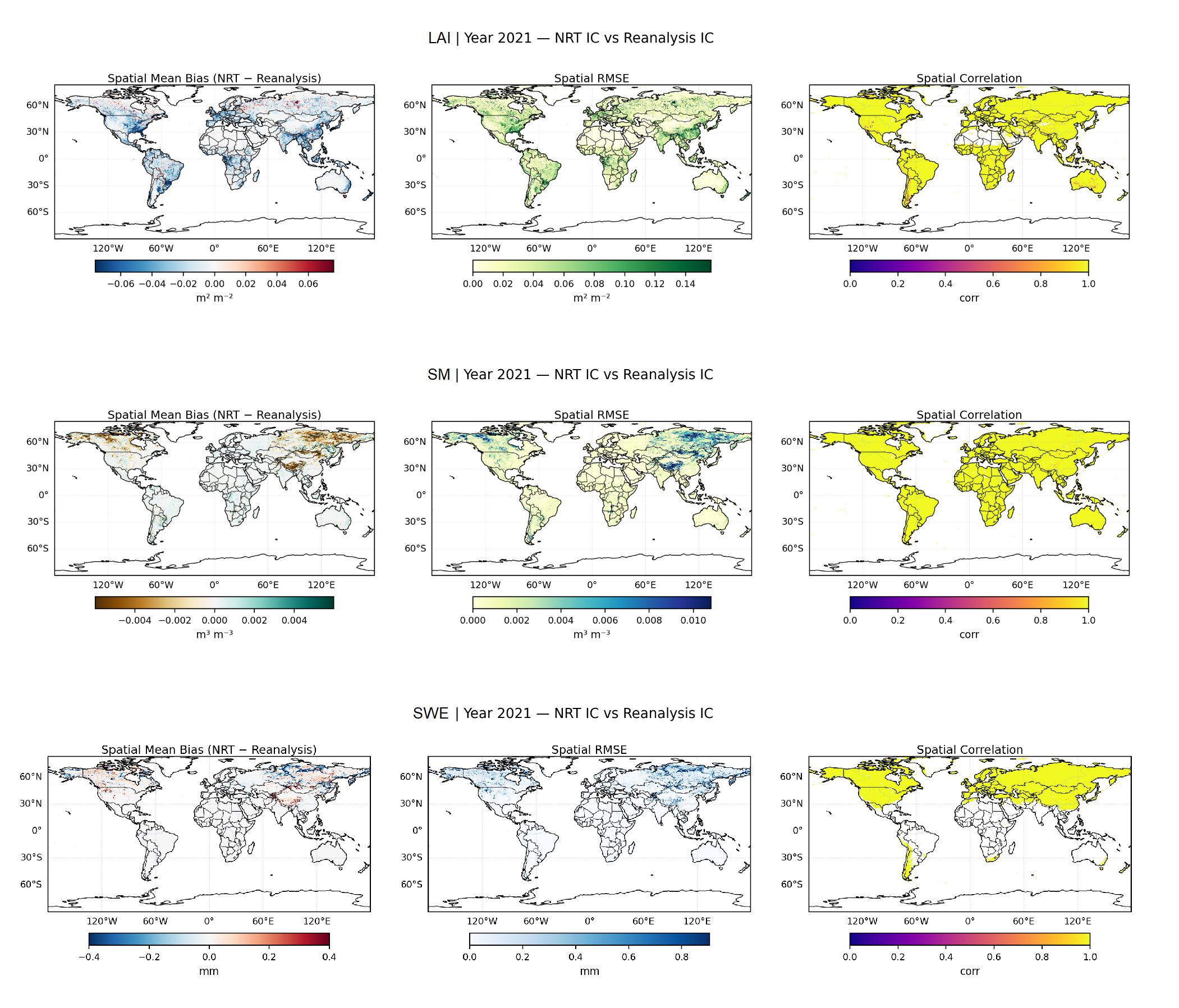
Figure 1: Global maps showing the agreement of the near-real-time analysis of the Météo-France prototype in 2021 with respect to the reference reanalysis in terms of (from left to right) mean bias, root mean square difference, and Pearson correlation coefficient, for (from top to bottom) leaf area index (m² m⁻²), soil moisture (m³ m⁻³), and snow water equivalent (kg m⁻²).