

Iris de Gelis, Jostein Blyverket, Filipe Aires, Catherine Prigent, Asmund Bakketun, Cyril Palerme, Harald Schyberg, Pete Weston
To assimilate data from passive microwave (MW) satellite instruments into numerical weather prediction (NWP) models, accurate observation operators are required to simulate model equivalents in observation space. This allows the calculation of first-guess departures which are a key ingredient to all data assimilation algorithms, quantifying the mismatch between the background state and the observation.
In the atmosphere, radiative transfer models such as RTTOV (Saunders et al, 2018) are used, which provide high quality estimates of the simulated top of atmosphere radiances given NWP model variables as inputs.
Over land, the quality of physics-based observation operators such as CMEM (de Rosnay et al, 2020) has not been sufficient to allow for the successful assimilation of surface sensitive passive MW instruments due to the large heterogeneity of land-surfaces.
In CERISE we have explored an alternative approach by training machine-learning (ML)-based observation operators to link the model variables to collocated observed radiances and the associated emissivities.
In this article we describe the development of ML-based observation operators for low frequency passive MW satellite instruments to enable the direct assimilation of L1 radiances over land. Two separate approaches are used to develop a global model and a regional model over Scandinavia.
The global model is trained using features from the ERA5 reanalysis and a surface water climatology whilst the regional model uses offline SURFEX model simulations. A variety of ML algorithms are explored including multi-layer perceptrons (MLPs) and graph neural networks (GNNs) amongst others. The global model uses observations from the SMOS, SMAP and AMSR2 instruments as targets whilst the regional model focuses on only AMSR2.
A thorough information content analysis is first performed to choose which model variables are most strongly correlated with the observed radiances or MW emissivities. See figure 1 for a correlation matrix showing the chosen features and targets over snow-covered areas. Then, using the chosen model features the ML observation operators are trained using historical data and validated using independent data not used in the training.
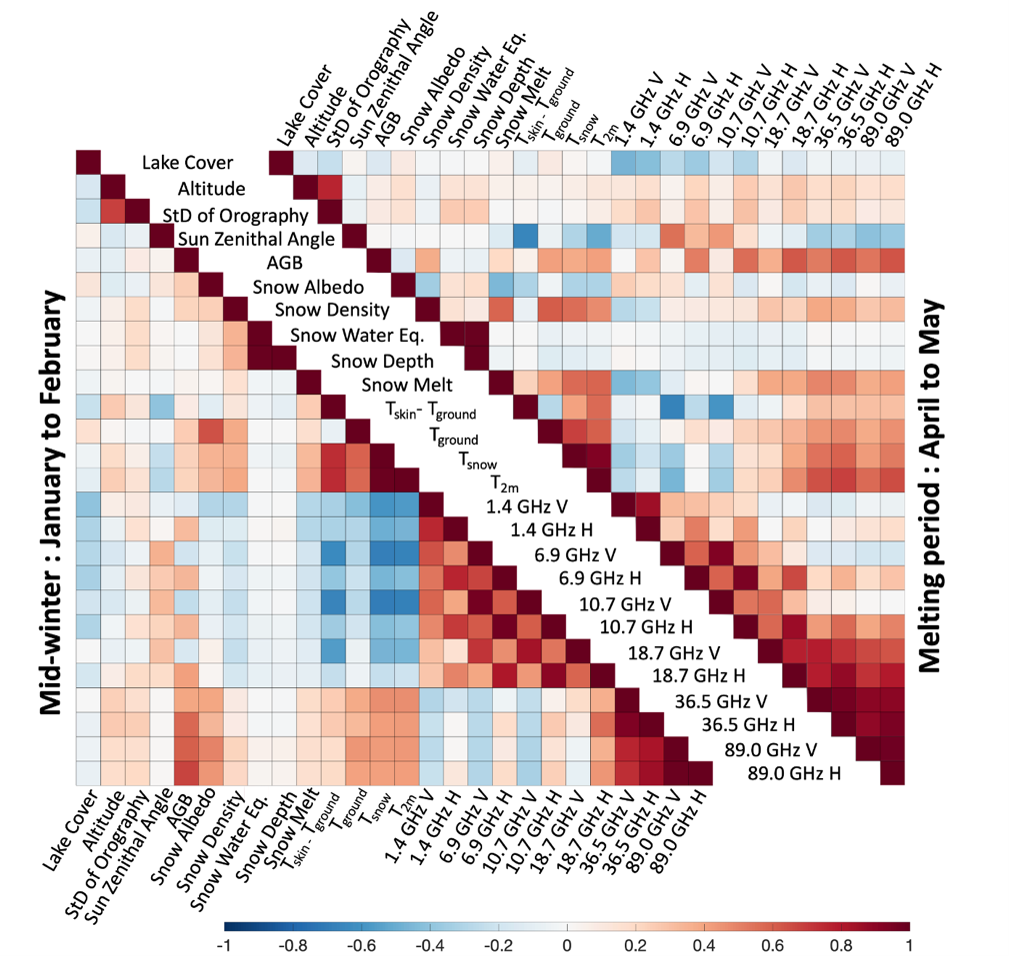
Figure 1: Correlation matrix of model variables and MW channels at different frequencies and polarisations observed from SMOS, SMAP and AMSR2 for snow-covered land.
The performance of the models is assessed by evaluating the predicted outputs against the targets using various statistical metrics including correlations and root mean squared errors. In addition, the ML observation operators are compared against alternative models such as climatologies of the outputs and
Initial results show improved performance over snow-covered regions for the global emissivity ML-based model when combined with climatologies compared to using the existing climatologies alone, see figure 2.
Over snow-free areas at higher frequencies the ML-based model struggles to outperform the climatologies due to smaller spatio-temporal variations in the emissivities and a lack of inter-annually varying predictors. At lower frequencies the ML-based model performs better where variations in emissivity are more strongly linked to soil moisture variations. For more details see de Gélis et al. (2025).
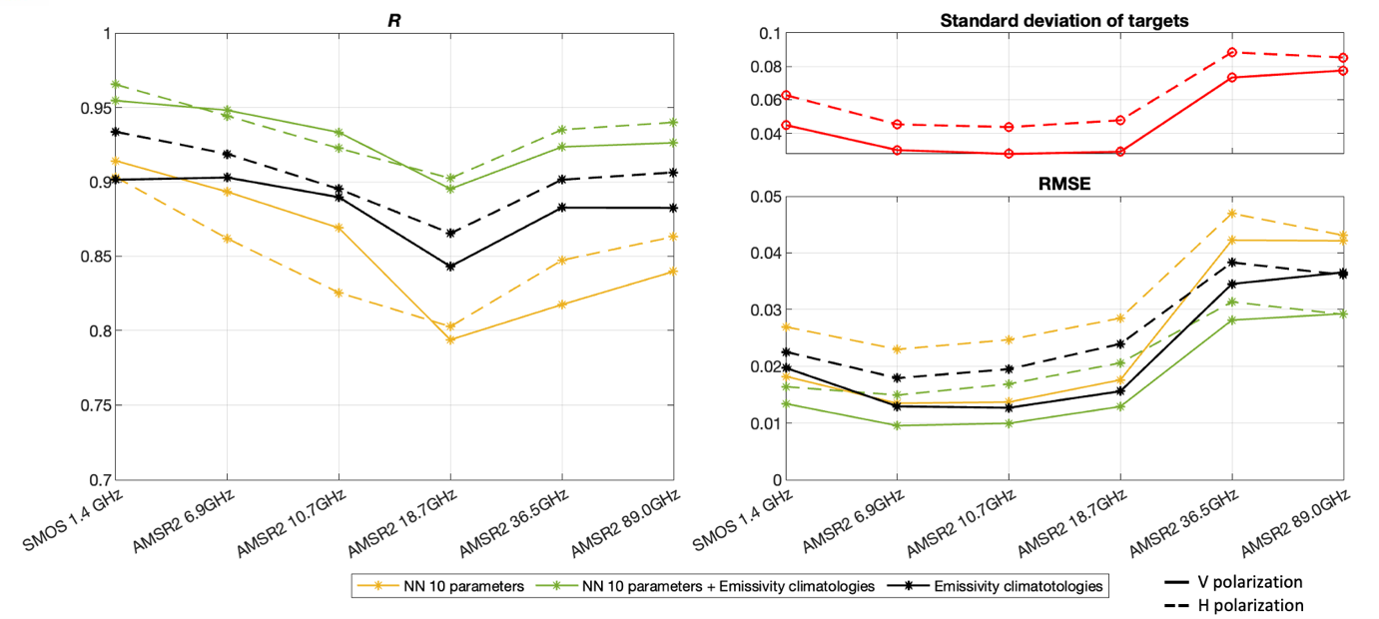
Figure 2: Evaluation of correlation (left panel) and root mean square error (right panel) between observed emissivities compared against simulated emissivities from climatologies (black), ML-based observation operator (gold) and a combination of the two (green) for snow-covered land.
For the models trained over the regional Scandinavian domain the performance varies depending on the time of year (related to snow accumulation and melting periods), location (with worse performance in complex terrain) and the choice of ML algorithm.
Several ML algorithms were compared including XGBoost, convolutional neural networks, residual U-net, and static and dynamic GNNs. The best performance is with the dynamic GNN but this is too computationally expensive to train, so the most promising algorithm is the static GNN.
The performance of this model compares favourably to the physics-based CMEM which is encouraging for future data assimilation experiments, see figure 3. For more details see Blyverket et al. (2026).
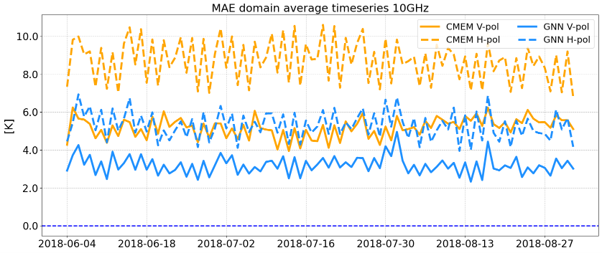
Figure 3: Time series of mean absolute error between predictions and targets for physics-based CMEM (orange) and static GNN (blue) for AMSR2 10GHz channel.
The results presented here both for the global and regional models suggest that ML-based observation operators perform better than existing state-of-the-art approaches based on emissivity climatologies or physics-based models. The next steps will be to run data assimilation experiments using these ML models to assess whether assimilating passive MW data over land leads to forecast improvements.
For more details the deliverable report D1.4 containing a full description of the methodology and results can be found here.
References
Blyverket et al., Manuscript in prep: Microwave observation operator for the land surface using static Graph Neural Networks (2026)
de Gélis, I., Prigent, C., Jimenez, C., & Sandells, M. (2025). Forward modelling of passive microwave emissivities over snow-covered areas at continental scale. Remote Sensing of Environment, 328, 114821. https://doi.org/10.1016/j.rse.2025.114821
de Rosnay, P., Munoz-Sabater, J., Albergel, C., Isaksen, L., English, S., Drusch, M., & Wigneron, J. P. (2020). SMOS brightness temperature forward modelling and long term monitoring at ECMWF. Remote Sensing of Environment, 237, 111424. ISSN 0034-4257, https://doi.org/10.1016/j.rse.2019.111424
Saunders, R., Hocking, J., Turner, E., Rayer, P., Rundle, D., Brunel, P., Vidot, J., Roquet, P., Matricardi, M., Geer, A., Bormann, N., and Lupu, C.: An update on the RTTOV fast radiative transfer model (currently at version 12), Geosci. Model Dev., 11, 2717–2737, https://doi.org/10.5194/gmd-11-2717-2018, 2018