

Ekaterina Vorobeva, Yvan Orsolini, Patricia de Rosnay, Jonathan Day, Retish Senan, Damien Decremer and Frederic Vitart
Snow plays an important role in the Earth's climate system, influencing how energy is exchanged between the land and atmosphere and how water is stored and released throughout the year. Understanding how much snow will accumulate during winter is therefore important for subseasonal-to-seasonal prediction, as well as for anticipating changes in water availability and potential hydrological risks.
Seasonal forecasts provide information about possible weather and environmental conditions over the coming months. Unlike short-range weather forecasts, they generally describe the likelihood of different outcomes rather than predicting exactly what will happen on a particular day.
However, a forecast is useful only if its probabilities provide a meaningful indication of what may occur. For example, when a forecasting system repeatedly assigns a certain probability to winters with low snow accumulation, those winters should occur at a frequency consistent with the forecast probabilities over time. This consistency is known as forecast reliability (e.g., Hsu and Murphy, 1986; Mason 2004). Although reliability assessment is among the diagnostic measures incorporated in the World Meteorological Organization Standardized Verification System for Long-Range Forecasts, the reliability of probabilistic seasonal snow forecasts has received much less attention that other variables like near-surface temperature and precipitation (e.g., Weisheimer and Palmer, 2014; Manzanas et al., 2018, 2022).
Assessing the reliability of snow forecasts
A new study carried out within the Work Package 6 of CERISE project has assessed the reliability of seasonal snow hindcasts[1] produced by the European Centre for Medium-Range Weather Forecasts (ECMWF). Vorobeva at al. (2026) examines 30 years of hindcasts (1993 to 2022) with the focus on snow water equivalent (SWE) variable that represents the depth of water that would result if the snowpack melted. The study focused on two types of winter: those with relatively low snow accumulation and those with relatively high snow accumulation. The assessment covered the Northern Hemisphere, excluding mountainous areas.
An important part of a forecast reliability assessment is deciding what to verify it against. The two reference datasets used are ERA5-Land, a land-surface reanalysis produced by ECMWF, and version 4 of the European Space Agency's Climate Change Initiative Snow product (ESA Snow-CCI), which combines satellite observations with measurements of snow depth from weather stations. Using two datasets allowed the study to investigate not only the performance of the forecasts, but also whether conclusions about their reliability remained consistent when different sources of snow information were used.
Overall, the seasonal snow hindcasts showed encouraging reliability (Figure 1, Vorobeva, E. et al 2026). Across the eight land regions, the ECMWF forecasts were consistently classified between marginally useful and perfect reliability for both low- and high-snow accumulation winters. However, the results appeared to be dependent on the reference dataset used. When the forecasts were evaluated against ERA5-Land, most regions received higher reliability categories than when they were assessed against ESA Snow-CCI. The differences highlight that the two reference datasets do not always describe the same snow conditions or identify the same winters as having unusually low or high snow accumulation. Differences in how snow is represented, and uncertainties in the reference data can all influence the assessment. The study also notes that ERA5-Land and the ECMWF hindcasts share some underlying atmospheric information, which may partly contribute to the higher reliability classifications obtained when using ERA5-Land. The findings therefore underline the importance of carefully selecting and comparing reference datasets when evaluating seasonal forecasts.
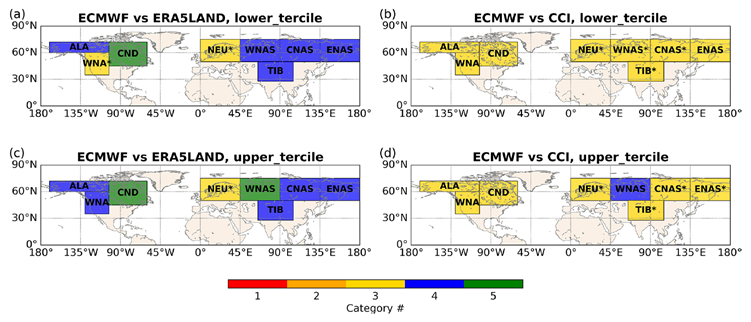
Figure 1. (Vorobeva, E. et al, 2026) Reliability of the ECMWF snow hindcasts in December-January-February 1993 - 2022 for low snow accumulation (lower tercile) winters and for high snow accumulation (upper tercile) winters assessed against ERA5-Land (a, c) and ESA Snow-CCI (b, d). Reliability categories are color coded (green – perfect, blue – useful, yellow – marginally useful, orange – not useful, red – dangerous, as in Weisheimer and Palmer, 2014).
Why does this matter for seasonal prediction?
Snow conditions can influence more than the winter landscape. Snow reflects a large proportion of incoming sunlight and insulates the ground, affecting exchanges of energy between the land and atmosphere. As snow melts, it also contributes to soil moisture and availability of water later in the year. Reliable information about seasonal snow conditions can therefore support research that focuses on the links between land-surface processes, weather and climate, and is important for operational seasonal prediction. Snow forecast information is also potentially relevant to managing water resources and to assessing hydrological risks.
By assessing the reliability of seasonal snow forecasts, CERISE project provides a new basis for understanding how well forecast probabilities represent wintertime snow accumulation across different regions in the Northern Hemisphere. It also shows why continued improvements in the elaboration of snow datasets and in the refinement of forecast evaluation methods are important. These efforts can help researchers better understand the strengths and limitations of seasonal snow prediction and contribute to the continued development of high-quality reanalysis and seasonal forecast products within the Copernicus Climate Change Service.
The study was funded by the European Union through the Copernicus Climate Change Service Evolution (CERISE) project (project id 101082139).
Full-text publication: Vorobeva, E., Orsolini, Y., de Rosnay, P., Day, J., Senan, R., Decremer, D., and Vitart, F. (2026). “On the reliability of seasonal snow forecasts”. The Cryosphere, 20, 4605–4618. https://doi.org/10.5194/tc-20-4605-2026
References:
Hsu, W.-r. and Murphy, A. H.: The attributes diagram a geometrical framework for assessing the quality of probability forecasts, Int. J. Forecasting, 2, 285–293, https://doi.org/10.1016/0169-2070(86)90048-8, 1986. a, b, c
Manzanas, R., Lucero, A., Weisheimer, A., and Gutiérrez, J. M.: Can bias correction and statistical downscaling methods improve the skill of seasonal precipitation forecasts?, Clim. Dynam., 50, 1161–1176, https://doi.org/10.1007/s00382-017-3668-z, 2018. a, b, c
Manzanas, R., Torralba, V., Lledó, L., and Bretonnière, P. A.: On the Reliability of Global Seasonal Forecasts: Sensitivity to Ensemble Size, Hindcast Length and Region Definition, Geophys. Res. Lett., 49, e2021GL094662, https://doi.org/10.1029/2021GL094662, 2022. a, b, c, d
Mason, S. J.: On using “climatology” as a reference strategy in the Brier and ranked probability skill scores, Mon. Weather Rev., 132, 1891–1895, https://doi.org/10.1175/1520-0493(2004)132<1891:OUCAAR>2.0.CO;2, 2004. a, b
Weisheimer, A. and Palmer, T. N.: On the reliability of seasonal climate forecasts, J. R. Soc. Interface, 11, 20131162, https://doi.org/10.1098/rsif.2013.1162, 2014. a, b, c, d, e, f
[1] Hindcasts are forecasts for past periods, produced using a forecasting system to assess how it performs against historical conditions.